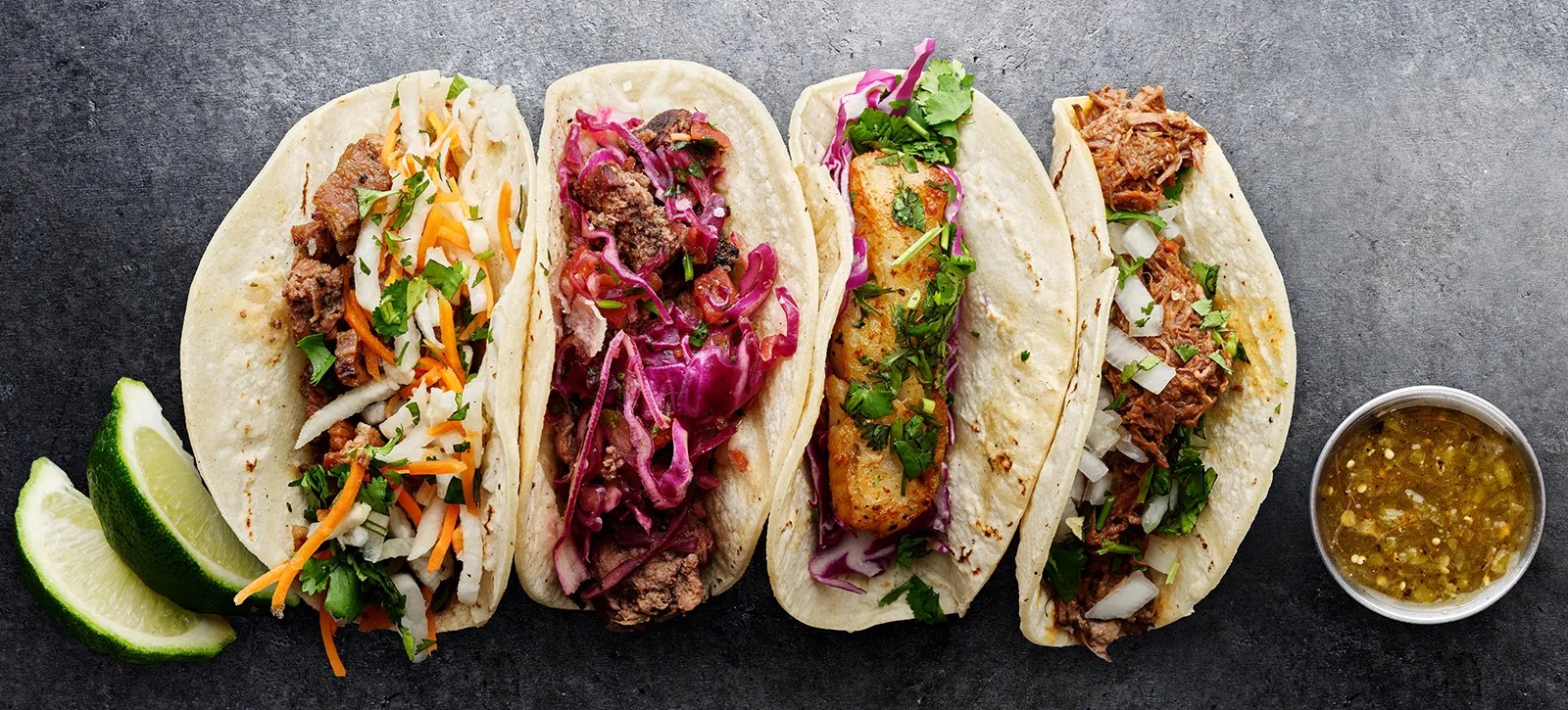
Tacos are one of the most iconic and beloved foods in Mexican cuisine. However, this food does not just end in Mexico. As tacos have traveled across countries, they’ve been transformed by new ingredients, cultural influences, and local tastes. This project explores how tacos have been adapted in different countries and states outside Mexico and questions what happens to a taco when it leaves its origin? How do these adaptations reflect stories about identity, migration, and cultural exchange?
To understand this global journey, I draw on insights from scholars who approach tacos from different angles. Food historian Jeffery Pilcher offers a historical and geographic perspective. In his research on Southwestern cuisine, Pilcher argues that Mexican food in the United States is a mestizo product. This is shaped by the blending of indigenous foodways, Spanish colonial traditions, and modern commercial forces. He shows how tacos evolved in the U.S. through cultural mixing and adaptation, especially in regions like Texas, where the food became a way to express both heritage and change. Pilcher’s work helps us to understand not seeing tacos as static or “authentic” objects, but as flexible, evolving symbols of identity.
On the other hand, Jose Ralat, a food journalist and taco editor for Texas Monthly, brings a contemporary lens. He documents the rise of Japanese Mexican fusion tacos in Texas. Ingredients that were incorporated into the tacos were sashimi, yakitori, sushi rice, mole, salsa, and kimchi de gallo. Ralat connects this trend to the historical Manila-Acapulco trade route, which linked Asia and Latin America during the colonial period. His work shows how tacos can serve as a canvas for cross-cultural creativity, especially in urban food scenes shaped by migration, memory, and innovation. Ralat’s perspective highlights how tacos continue to evolve in surprising ways.
By scrolling through my 10 entries, viewers will see how tacos have been reimagined in the Philippines and places in the United States like Texas, California, and New York. Each entry focuses on a specific adaptation, whether it’s a fusion of tacos, street food, or a fast-food reinvention. It connects it to local histories, ingredients, and cultural meanings. My argument is that tacos are not just traveling but evolving. Those transformations reveal stories about belonging and how people use food to express who they are. This topic matters because food is not just about eating, but it’s about culture, memory, and belonging. Tacos show how a street food can become a global symbol, reshaped by migration, colonial history, and creative exchange. By mapping these adaptations, viewers can understand how cultural identity is built through everyday practices like cooking, eating, and sharing.
Sources:
Bond, Courtney. 2014. “Puffy Tacos.” Texas Monthly. July 16, 2014. https://www.texasmonthly.com/food/puffy-tacos.
Cooper-Richet, Diana. 2017. “The History of Real Del Monte, Mexico’s Little Slice of Cornwall.” The Conversation. August 30, 2017. https://theconversation.com/the-history-of-real-del-monte-mexicos-little-slice-of-cornwall-83117.
Johnson, Chrystal. 2022. “Blue Corn Tortillas.” Happy Mothering. June 14, 2022. https://www.happy-mothering.com/blue-corn-tortillas.
McNamee, G.L. “taco.” Encyclopedia Britannica, October 13, 2025. https://www.britannica.com/topic/taco.
Miller, Megan. 2023. “Classic Mexican Taco Recipe (Steps + Video!) | How to Cook.Recipes.” How to Cook.Recipes. August 11, 2023. https://www.howtocook.recipes/classic-mexican-taco-recipe/.
Pilcher, Jeffrey M. “‘Old Stock’ Tamales and Migrant Tacos: Taste, Authenticity, and the Naturalization of Mexican Food.” Social Research 81, no. 2 (2014): 441–62. https://www.jstor.org/stable/26549626
Pilcher, Jeffrey M. “Tex-Mex, Cal-Mex, New Mex, or Whose Mex? Notes on the Historical Geography of Southwestern Cuisine.” Journal of the Southwest 43, no. 4 (2001): 659–79. http://www.jstor.org/stable/40170174.
Pilcher, Jeffrey M. “Was the Taco Invented in Southern California?” Gastronomica 8, no. 1 (2008): 26–38. https://doi.org/10.1525/gfc.2008.8.1.26.
Ralat, José R. 2020. “Are Japanese Tacos The Next Big Thing? Two New Dallas Concepts Combine Asian and Mexican Flavors and Methods, with Remarkably Modern Results.” Texas Monthly 48 (11): 26–28. EBSCOhost.
Ralat, José R. 2025. “A New Mexican-Japanese Taqueria Is off to a Promising Start, but Could Amp up Its Dedication to Fusion.” Texas Monthly. May 30, 2025. https://www.texasmonthly.com/food/shogun-taqueria-fort-worth.
Ralat, José R. “Jewish and Kosher Tacos, or Deli-Mex: Glatt, Good Eating, and Pastrami Tacos.” In American Tacos: A History and Guide, 161–75. University of Texas Press, 2024. http://www.jstor.org/stable/10.7560/329368.9.
Sietsema, Robert. 2017. “4 Excellent Pastrami Tacos to Try in NYC.” Eater NY. May 12, 2017. https://ny.eater.com/2017/5/12/15630040/best-pastrami-tacos-nyc.
“Tagged – Taco Bell.” 2025. Eat This Not That. 2025. https://www.eatthis.com/tag/taco-bell.
